

Wechat QR code
Wechat QR code

15311826613
Click to add WeChatHigh-sulfide gold ores contain high levels of sulfide minerals such as pyrite and arsenopyrite, resulting in lower gold grades. The natural gold particles are fine and usually tightly encapsulated by sulfide minerals like pyrite. Direct cyanide leaching is unsuitable for this type of gold. Flotation is an economical and reasonable process with significant advantages in beneficiating high-sulfide gold ores. It concentrates gold in copper, lead, and sulfur concentrates, from which gold can then be extracted. This not only allows for the comprehensive utilization of multiple metals but also improves gold recovery. Below, we will explore a sulfide gold ore beneficiation process.
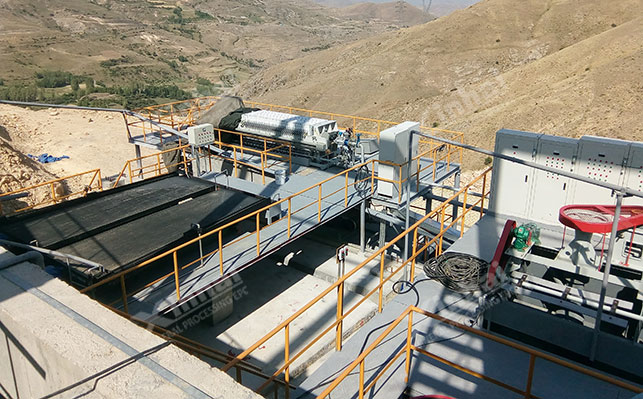
The gravity separation-flotation process is suitable for ores where gold and sulfides are tightly coexisting, and gold can only be recovered through smelting. It is also suitable for coarse-grained gold-bearing quartz vein ores with uneven particle sizes. The raw ore is floated to obtain a flotation concentrate. However, the flotation tailings often contain sulfides associated with the gangue, and the coarse-grained native gold encapsulated in these sulfides is difficult to recover by flotation. To effectively recover this portion of gold, gravity separation equipment is used to recover the coarse-grained gold first, thereby improving the gold recovery rate of the entire gold ore beneficiation process. Commonly used gravity separation equipment includes jigs, shaking tables, and spiral sluices.
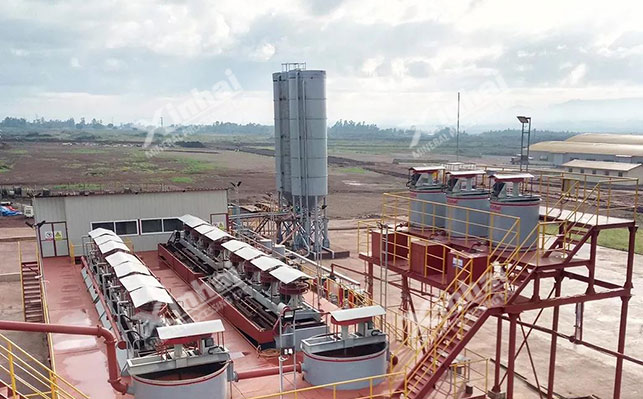
The flotation-concentrate cyanidation process is commonly used to process gold ore from gold-bearing quartz veins and gold-bearing pyrite quartz veins. Typically, xanthate is used as the collector, and pine oil as the frother, and flotation is performed in a weakly alkaline pulp to obtain a gold concentrate. Subsequently, the flotation concentrate is leached with cyanide, the gold is dissolved by the cyanide, the complex enters the solution, and is then replaced with zinc powder to obtain gold mud, which is then smelted by pyrometallurgy to obtain pure gold. This gold ore flotation process not only reduces fine grinding of all ores, lowering power consumption and infrastructure investment, but also improves gold recovery.
For complex ores with particularly high sulfide content, such as sparingly soluble gold-arsenic ore, gold-zinc ore, and gold-iron ore, the flotation-roasting-cyanidation process is an effective integrated treatment. When processing flotation concentrates with high arsenic and sulfur content, cyanidation tailings often accumulate impurities such as sulfur, iron, and arsenic after flotation, forming high-sulfur, high-arsenic concentrates that are difficult to directly cyanidate. Therefore, these flotation gold concentrates are first oxidized and roasted. This not only effectively removes arsenic and sulfur but also loosens the grain structure of the roasted sand, which is beneficial for further leaching of gold and silver.
It is particularly suitable for processing vein gold ores containing arsenic, sulfur, or carbon and with high clay content. This process first uses flotation to enrich gold-bearing sulfides into a concentrate, then leaches it with thiourea. Thiourea acid solution has a rapid dissolving ability for gold and silver, and thiourea has low toxicity and is easily regenerated. Thiourea leaching is unaffected by mineral components such as antimony, arsenic, copper, and sulfur, which often interfere with gold extraction from cyanide. Therefore, the thiourea leaching process can effectively extract gold and silver from gold-bearing ores that are difficult to process with cyanide. Compared with cyanide leaching, thiourea leaching requires significantly less time, thus improving gold extraction efficiency.
Gold ores are diverse, and the suitable gold ore beneficiation processes vary. Therefore, before selecting a beneficiation process, it is necessary to conduct beneficiation tests and analyses on the ore. Based on a scientifically sound test report, a beneficiation process tailored to the ore's characteristics can be customized. This not only improves gold extraction efficiency but also reduces production costs, achieving economical and environmentally friendly mining, thereby achieving an ideal recovery rate.
 CHAT
CHAT MESSAGE

 Consult
 Message
