

Wechat QR code
Wechat QR code

15311826613
Click to add WeChatHematite is one of the main minerals for obtaining iron resources. Due to differences in mineral properties and quality conditions, the nature of hematite varies in nature. Therefore, flotation is often used as the main process. This article will mainly introduce the hematite flotation methods.
The main chemical component of hematite is Fe₂O₃. Its crystal structure has various variants, with the corundum-type structure being the most common. In this structure, iron ions are located in the octahedral voids composed of oxygen ions, resulting in a relatively stable structure and classifying it as a weakly magnetic mineral. Hematite often occurs as oolitic, reniform, or massive aggregates. The intergrowth relationship between hematite and gangue minerals in the ore is diverse. In some ores, hematite is dispersed in the form of fine or microparticles within the gangue minerals, and the gangue minerals are numerous, such as quartz and calcite, making the flotation separation of hematite quite challenging. The two most commonly used flotation methods are direct flotation and reverse flotation.
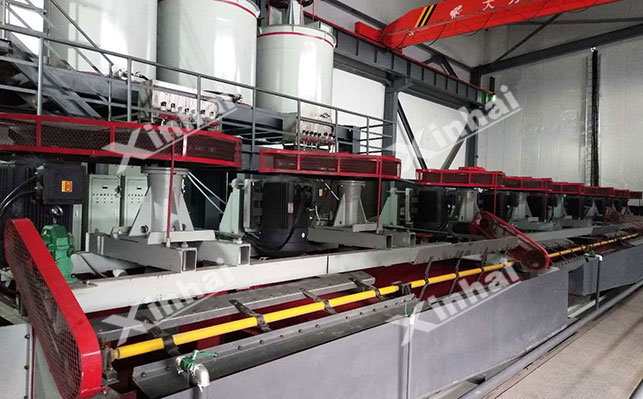
This method directly floats hematite to the surface. A modifier is added to the pulp to adjust the pH, creating an environment conducive to hematite flotation. Then, a collector is added, which chemically adsorbs iron ions from the hematite surface, making the surface hydrophobic. A frother is then added to generate bubbles, which the hematite particles adhere to and float to the surface of the pulp, where they are scraped off as iron concentrate, while the gangue minerals remain in the pulp. This process is sensitive to impurities such as calcium and magnesium ions in the pulp, requiring pretreatment to remove these impurities and improve flotation efficiency.
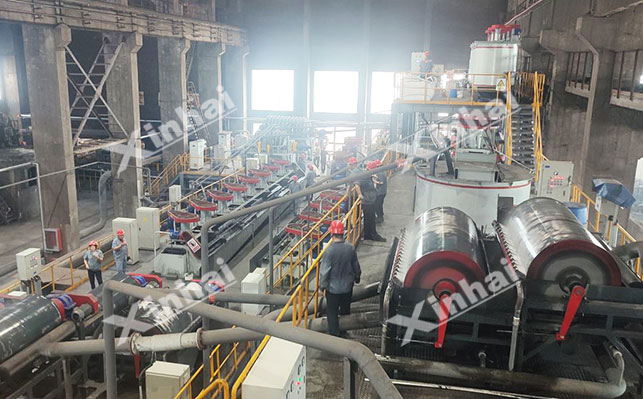
This method first floats the gangue minerals to the surface, leaving the hematite in the pulp. Generally, anionic collectors (such as sodium dodecyl sulfate) are used. Under suitable pH conditions, the anionic collector adsorbs onto the surface of gangue minerals such as quartz, making the surface hydrophobic. The gangue floats under the action of air bubbles, while hematite remains in the pulp. This process has high requirements for the selectivity and dosage of the anionic collector, and requires control of the pulp pH and flotation conditions. Simultaneously, the reverse flotation process has strict requirements for the particle size distribution of the pulp; excessively coarse or fine particles will affect the flotation effect.
The above is an introduction to two hematite flotation methods. In actual production, due to the complex composition and diverse types of hematite ore, there is no fixed beneficiation scheme. Therefore, it is necessary to first conduct beneficiation experiments and analyze the situation to design a suitable hematite beneficiation method, which is key to obtaining high-grade hematite concentrate.
Xinhai has extensive experience in hematite beneficiation methods. Whether it is magnetic separation, flotation, or combined beneficiation processes, we tailor process schemes according to the ore properties. Please feel free to contact Xinhai if you have any needs!
 CHAT
CHAT MESSAGE

 Consult
 Message
