

Wechat QR code
Wechat QR code

15311826613
Click to add WeChatIron ore is a crucial raw material for the steel industry, and its quality directly impacts the performance and quality of steel products. There are many types of iron ore in nature, each with unique properties, necessitating different flotation processes for efficient separation. This article primarily introduces magnetite ore flotation methods.
The main chemical component of magnetite is Fe₃O₄, with an inverse spinel crystal structure. Oxygen ions are cubically close-packed, while iron ions are distributed within the octahedral and tetrahedral voids formed by oxygen ions, giving it strong magnetism. Magnetite often occurs in association with hematite, pseudomorphous hematite, etc., resulting in a complex ore structure. In some deposits, magnetite is predominantly coarse-grained, facilitating liberation through simple crushing and grinding; however, in other deposits, the magnetite is extremely fine-grained, closely associated with gangue minerals, increasing the difficulty of beneficiation. Common flotation methods mainly include reverse flotation and combined magnetic-flotation processes.
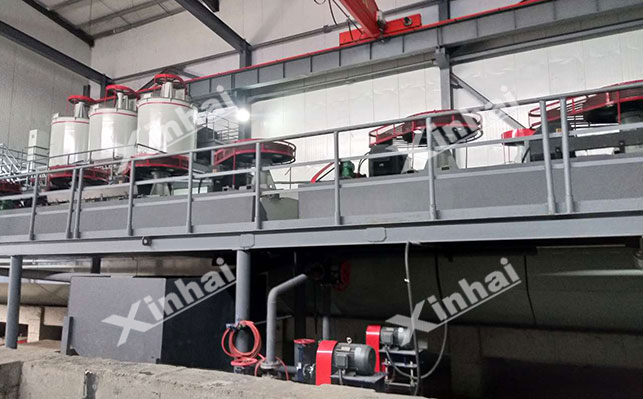
This process floats gangue minerals from the magnetite concentrate while leaving the magnetite in the pulp. Cationic collectors, such as amine collectors, are typically used. Under appropriate pH conditions, the amine collector adsorbs onto the surface of gangue minerals like quartz, making their surface hydrophobic. These minerals float under the influence of air bubbles, while the magnetite, not adsorbed by the collector, remains in the pulp, thus achieving separation.
This process first utilizes the strong magnetism of magnetite to initially enrich it through magnetic separation, obtaining a magnetic concentrate and tailings. The magnetic concentrate is then regrinded to further improve the liberation of the magnetite. The regrinded pulp is then treated using flotation to remove residual gangue minerals. For the tailings, a suitable flotation method can be selected based on the nature and content of the residual iron minerals to improve iron recovery. This process is suitable for processing magnetite ore with uneven particle size and containing various gangue minerals, effectively improving iron recovery and concentrate grade.
This is an introduction to magnetite flotation methods. In actual concentrators, different types of iron ore have different chemical compositions, crystal structures, and physical properties, therefore, different flotation methods are used. It is necessary to comprehensively consider factors such as the properties of the iron ore, its composition, grade requirements, and economic benefits to select a suitable flotation process method to achieve efficient utilization of iron ore resources.
 CHAT
CHAT MESSAGE

 Consult
 Message
