

Wechat QR code
Wechat QR code

15311826613
Click to add WeChatSilver is an important precious metal and strategic resource, possessing excellent electrical and thermal conductivity and ductility. It is widely used in high-end electronics, aerospace, defense weaponry, jewelry, and other fields, demonstrating significant economic value and strategic importance. Pure silver raw materials require extraction through specialized beneficiation processes. Common silver ore beneficiation methods include flotation, gravity separation, and cyanidation. Among these, silver ore gravity separation is widely used due to its advantages of low cost, no pollution, and suitability for recovering both coarse and fine-grained silver minerals. This article will detail the silver ore gravity separation process.
The conventional silver ore beneficiation process mainly consists of three core stages: ore pretreatment, silver ore gravity separation, and product processing. These stages are closely linked and directly affect the recovery rate of silver ore gravity separation and the grade of silver concentrate.
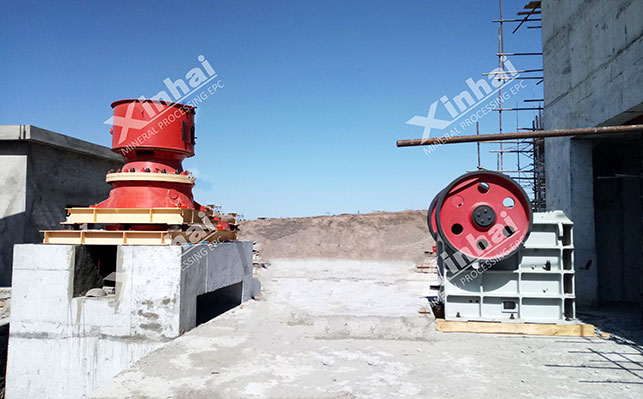
As a crucial pre-processing step for silver ore gravity separation, it mainly includes four steps: crushing, screening, grinding, and classification. The raw silver ore, after mining, typically has a particle size of 500-1500mm and requires multi-stage crushing: coarse crushing uses a jaw crusher to reduce the ore to 150-200mm; medium crushing uses a cone crusher, controlling the output particle size to 25-50mm; and fine crushing uses an impact crusher to ultimately refine the particle size to 10-25mm. Screening uses a vibrating screen; qualified material proceeds to the next process, while unqualified material is returned to the crusher for further crushing. The grinding stage uses a ball mill, adjusting the grinding concentration (65%-75%) and steel ball ratio according to the ore hardness to grind the ore to a particle size distribution of 60%-80% at -0.074mm. Classification uses hydrocyclones or spiral classifiers to separate coarse and fine particles, ensuring sufficient liberation of silver minerals from gangue, laying a solid foundation for subsequent silver ore gravity separation.
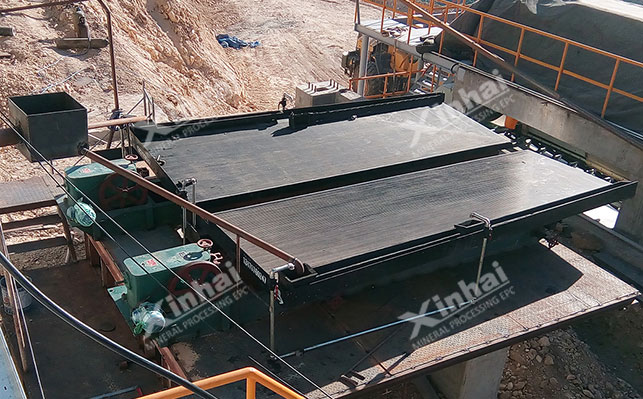
As the core separation stage, this mainly includes three commonly used methods, which can be flexibly combined according to the ore particle size. Shaking table separation is suitable for silver ore with a particle size of 0.03-2mm. It separates silver minerals (density approximately 10.5 g/cm³) from gangue (density 2.5-3.5 g/cm³) through differential motion of the bed surface and lateral water flow, utilizing the density difference. Adjusting parameters such as bed slope and feed rate can increase the silver concentrate grade by 3-5 times. Spiral sluice separation utilizes the combined action of centrifugal force and gravity to separate ore with a particle size of 0.02-2mm. As the slurry flows within the sluice, silver minerals, due to their higher density, are closer to the bottom and discharged along the inner side of the spiral, while gangue moves to the outer side. The equipment's processing capacity can reach 3-8 t/h. Centrifugal concentrators have a good recovery effect on silver minerals with a particle size of -0.03mm. Controlling the drum speed at 800-1200 r/min increases the settling velocity of silver minerals by 10-20 times, and the recovery rate is 15%-20% higher than traditional gravity separation equipment.
This is the final step in silver ore gravity separation, directly determining product quality and environmental compliance. Silver concentrate is concentrated using a high-efficiency thickener (with the addition of polyacrylamide flocculant, at a dosage of 5-15 g/t), then dewatered using a vacuum filter or chamber filter press to reduce moisture content to 10%-20%, meeting subsequent smelting requirements. After dewatering, tailings are neutralized and heavy metals are solidified by adding lime, sodium sulfide, and other reagents. After compaction, the tailings are dry-piled or used to fill mined-out areas, achieving a compaction density of 1.6-1.8 t/m³ to prevent secondary pollution and achieve environmental compliance.
In actual concentrators, the selection of the silver ore gravity separation process must consider multiple factors, including ore properties, silver ore grade, plant scale, environmental requirements, and economic benefits. Through concentrator experiments and techno-economic comparisons, the most suitable process parameters and flow combinations are determined. Xinhai Mining has extensive experience in silver ore beneficiation, providing services such as silver ore beneficiation testing, silver ore gravity separation process design, complete equipment supply, and subsequent operation and management. It has successfully completed several silver ore beneficiation projects, including a 500t/d project in Morocco and a 300tpd project in Myanmar.
Xinhai Mining has rich experience in silver ore beneficiation, capable of conducting silver ore beneficiation tests, designing silver ore beneficiation processes, providing complete beneficiation equipment, and providing subsequent beneficiation plant operation and management services. Xinhai has completed several silver ore beneficiation projects,
The 500t/d silver ore beneficiation project in Morocco: Through experimental analysis, Xinhai designed the following process flow for this project: two-stage semi-closed-circuit crushing and screening – two-stage closed-circuit grinding – one roughing, three scavenging, and two cleaning flotation stages – five-stage washing – zinc powder replacement smelting – tailings dry discharge process flow.
Myanmar 300tpd Silver Mine Beneficiation Project: Xinhai Mining designed the following process flow: two-stage closed-circuit crushing - one-stage closed-circuit grinding and classification - gravity separation - flotation with one roughing, three scavenging, and three cleaning stages - tailings dewatering.
Inner Mongolia 1200t/d Wet Manganese-Silver Leaching Beneficiation Project: Xinhai Mining's Inner Mongolia silver-manganese mine project has a designed capacity of 1200t/d, with beneficiation products mainly being silver concentrate and manganese concentrate. Based on the ore properties, Xinhai Mining, through beneficiation tests, tailored a fully wet manganese-silver leaching process, the flow of which is: three-stage closed-circuit crushing and screening - two-stage closed-circuit grinding - SO2 manganese leaching - cyanide silver leaching.
The Inner Mongolia Zhuhe 5000t/d Silver Polymetallic Mine Beneficiation Project: This Inner Mongolia silver polymetallic mine has a complex mineral composition. The gold-bearing minerals are silver-gold deposits, while the silver-bearing minerals are mainly argentite, native silver, and copper-silver sulfide, followed by other metals and gangue minerals. Xinhai, through experimental analysis, designed a process flow for this silver mine: two-stage continuous grinding – flotation – comprehensive concentrate regrinding – two-leaching and two-washing – zinc powder replacement.
 CHAT
CHAT MESSAGE

 Consult
 Message
